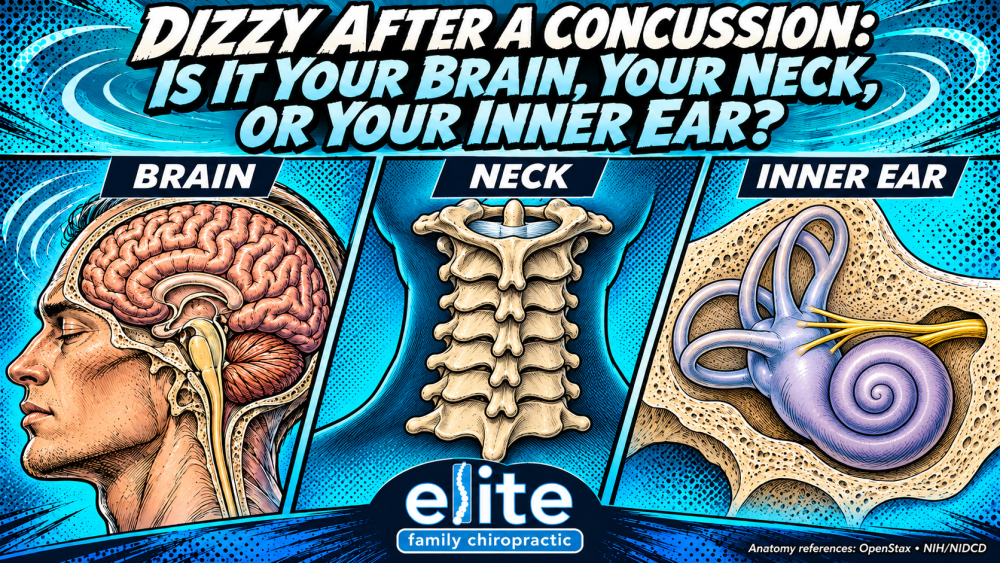
Dizzy After a Concussion: Is It Your Brain, Your Neck, or Your Inner Ear?
By Dr. Brad Gorski, DC, FSBT — Elite Family Chiropractic, Charleston, SC
You roll over in bed, and the room spins. Or you walk through a busy store and feel off balance. Maybe turning your head makes you feel as though your eyes cannot keep up.
These can all fall under one word: dizzy.
When someone tells me they feel dizzy after a concussion, I want to know what that means for them. What brings it on? How long does it last? What else do they feel?
Those details help guide the exam. Dizziness after an injury can involve the inner ear, the brain’s balance and vision systems, and sometimes problems in the neck. More than one issue may need care.
Why one injury can affect your balance in several ways
Your brain uses signals from your eyes, inner ears, muscles, and joints to keep you steady. Your neck helps tell your brain where your head is in relation to your body.
A car wreck, fall, or sports injury can affect more than one part of this system. A concussion and a neck injury can happen in the same event. An inner ear problem may also be present.
That is why I consider both concussion symptoms and possible neck injuries when assessing someone after a car wreck.
When the inner ear may be involved
One cause is BPPV, a type of inner ear vertigo. Vertigo means a false sense that you or the room is moving or spinning.
BPPV happens when tiny crystals move into the wrong part of the inner ear. This can send confusing movement signals to the brain. It can occur after a head injury.
Common clues include:
-
Spinning when you roll over in bed.
-
Spinning when you look up or change head position.
-
Short bursts that ease when you stay still.
A trained provider can use head-position tests to look for BPPV. One is the Dix-Hallpike test. Other tests may be needed, depending on which part of the inner ear is affected. After trauma, the provider first needs to check that the neck can safely tolerate the test.
If BPPV is confirmed, a guided series of movements can help move the crystals back. The Epley maneuver treats a common form of BPPV; other forms need different movements. [1, 2]
When the neck may be part of the problem
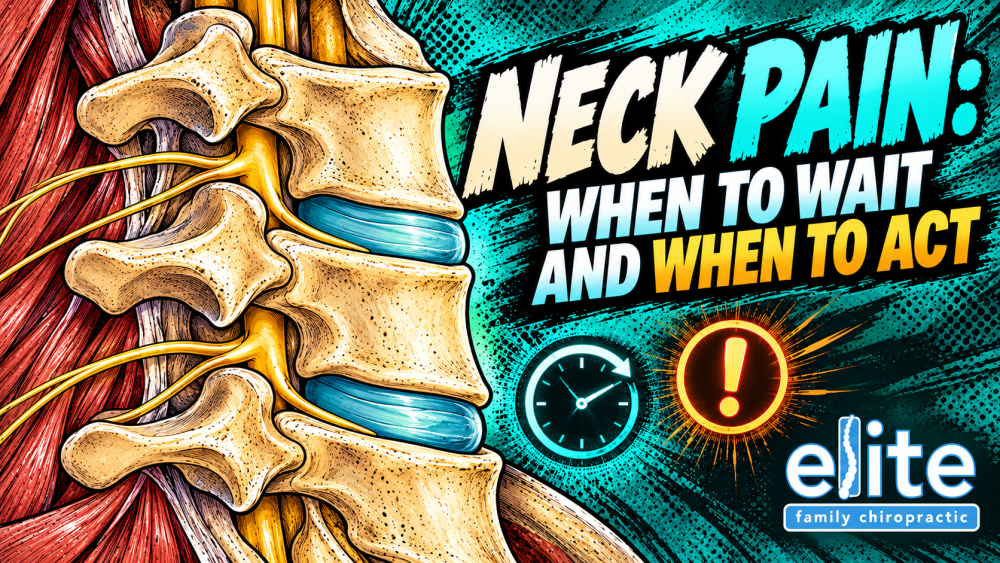
After a whiplash injury, you may have neck pain, stiffness, headaches, and dizziness at the same time.
Neck problems may contribute to a sense of imbalance in some people. But neck pain and dizziness together do not prove that the neck is the cause. Many inner ear problems also get worse when you move your head.
The term cervicogenic dizziness means dizziness thought to come from the neck. There is no single accepted test that proves this, and experts still debate how to diagnose it. Other causes, such as inner ear disorders and migraine, need careful review. [3]
My approach is to assess the neck while keeping the rest of the picture in view. A sore neck deserves attention, but it does not explain every balance problem.
When balance and vision are not working well together
A concussion can affect how your brain handles movement and visual signals. You may notice:
-
Feeling unsteady in a busy store or crowd.
-
Trouble reading or following moving objects.
-
Symptoms while scrolling on a phone.
-
Dizziness or headache that builds during activity.
These symptoms can guide further testing, but they do not pinpoint the cause by themselves. Migraine, eye problems, and inner ear disorders can cause similar symptoms. [2]
Feeling faint when you stand up also needs attention. Blood pressure changes, dehydration, and medicines may be part of that picture.
What the symptoms can tell us
| Pattern you notice |
What it may prompt us to check |
| Brief spinning when rolling in bed |
BPPV and other inner ear causes |
| Dizziness with neck pain or stiffness |
The neck, along with other possible causes |
| Trouble in busy stores or on screens |
Vision, balance, and migraine-related problems |
These are clues, not a diagnosis. Symptoms can overlap, which is why the exam matters.
What a useful evaluation includes
I start with how the injury happened and how your symptoms affect daily life. Trouble driving, reading, working, or walking through a store helps show what needs attention.
Depending on your symptoms, an evaluation may include:
-
A review of headaches, hearing changes, medicines, and past injuries.
-
Checks of strength, feeling, reflexes, and coordination.
-
A neck exam.
-
Screening of balance and eye movements.
-
Specific inner ear testing when appropriate.
Some findings call for further testing with a vestibular physical therapist, neurologist, eye-care provider, or ear, nose, and throat doctor. Part of my role is helping you reach that care.
How the findings guide treatment
The plan should match the problem found during the exam.
-
BPPV: A trained provider uses the right repositioning maneuver for the affected ear canal.
-
Balance problems: Vestibular rehabilitation uses tailored exercises to help with balance and keeping your vision steady as you move.
-
Neck pain and limited movement: Care may include suitable hands-on treatment and exercises for the neck. Improvement in neck pain alone does not prove that a concussion has healed.
-
Symptoms during activity: A guided, gradual return to activity can help. The plan should account for symptoms and the risk of another injury.
-
Other causes: Migraine, blood pressure changes, or eye problems may need a different provider or treatment plan.
Follow-up matters. If you are not improving, the next step may be to reassess the cause or bring another provider into your care. [2, 4]
When dizziness needs emergency care
After an injury, call 911 or seek emergency care for dizziness with any of these signs:
-
New weakness, slurred speech, or major trouble walking.
-
A worsening headache or repeated vomiting.
-
Double vision or one pupil larger than the other.
-
A seizure, growing confusion, or trouble waking up. [5]
Common questions
Can I have a concussion without hitting my head?
Yes. A force to the body can move the head and brain quickly enough to cause a concussion. You do not have to hit your head or pass out. The same event can also injure your neck.
Why am I still dizzy if my MRI was normal?
A normal scan does not rule out a concussion or many causes of dizziness. Scans look for certain structural problems. Your history and exam help assess how the balance system is working. Learn more about concussion symptoms with a normal MRI.
Should I wait a few weeks to get checked?
New dizziness after an injury deserves prompt evaluation. If you have already been assessed, follow your care plan and report worsening symptoms. Symptoms that have not gone away within two to three weeks need follow-up. That is not a reason to delay the first exam. [4]
Get help with dizziness after an injury
If dizziness is keeping you from work, sleep, or daily life, the next step is to find out what needs attention.
At Elite Family Chiropractic in West Ashley, I assess possible neck injuries, screen for concussion-related concerns, and help coordinate further care when needed. Your plan may involve more than one provider.
Call our office at 843-892-5671 to schedule an evaluation.
Sources
-
MedlinePlus — Benign positional vertigo
-
Living Concussion Guidelines — Vestibular and vision symptoms
-
Bárány Society — Position on cervical dizziness
-
CDC — What to do after a concussion
-
CDC — Concussion signs, symptoms, and danger signs
Author
 Brad Gorski DC, FSBT
At Elite Family Chiropractic in Charleston, South Carolina, Dr. Brad Gorski is a top-ranked chiropractor offering effective treatment options for back pain, knee pain, neck and shoulder pain, sciatica, migraines, pinched nerves, herniated discs, and more. Dr. Gorski received his Doctor of Chiropractic degree from Palmer College of Chiropractic in Davenport, Iowa in 2008. He has completed extensive post-graduate training, becoming qualified in Hospital Based Spine Care, MRI Interpretation Review, and Trauma while also completing a Fellowship in Spinal Biomechanics and Trauma. He provides chiropractic care and helps his patients achieve their goal of optimum health and wellness.