How to Recover From a Lumbar Disc Flare-Up
By: Brad Gorski, DC, FSBT | Elite Family Chiropractic
That sharp catch when you stand up, roll over in bed, or put on your shoes can stop you in your tracks. When your low back flares, it is natural to wonder whether you have done more damage.
Recovering from a lumbar disc flare-up usually starts with reducing activities that aggravate symptoms, keeping up gentle movement, and gradually rebuilding strength and tolerance. Severe pain does not automatically mean permanent damage, but understanding what is causing your symptoms helps guide the right next step.
In my office, the first thing I want to understand is what is causing the pain. A disc, a spinal joint, or surrounding muscles and connective tissues can produce overlapping symptoms. Getting that distinction right helps us choose care that fits your condition.
What Does a Lumbar Disc Flare-Up Mean?
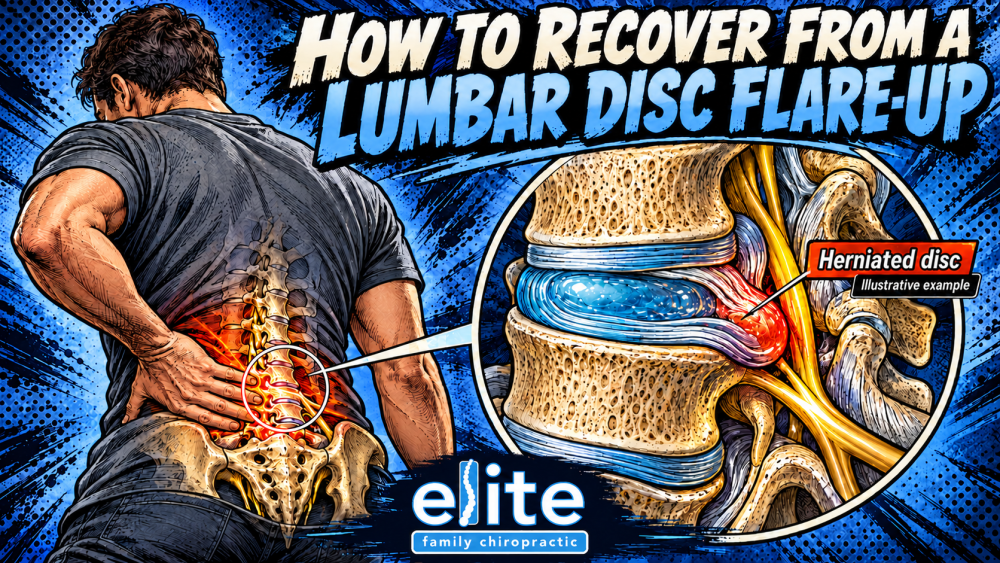
Your lumbar discs are cushions between the bones in your lower back. A flare-up describes an increase in symptoms; it does not tell us exactly what changed inside the spine.
An irritated disc may cause back pain. When a nearby nerve root becomes inflamed or compressed, symptoms can include burning, tingling, numbness, or pain traveling into the leg. This can produce sciatica.
Even if an earlier MRI showed a herniated disc, we still need to match that finding to your current symptoms and examination.
What to Do During the First Few Days
Stay Gently Active
Brief rest may help when pain is intense, but spending days in bed is generally unhelpful. Try short walks and change positions throughout the day as tolerated. You do not need to force a long walk to make progress.
If sitting aggravates symptoms, alternate it with standing or walking. If a certain movement repeatedly brings on sharp pain, reduce it temporarily. The goal is to find an amount of movement you can manage and build from there.
Find Comfortable Positions
Some people feel better lying on their back with a pillow under their knees. Others prefer their side with a pillow between their knees. Use the position that eases your symptoms, and change it when you become uncomfortable.
Think of an irritated back like a sprained ankle: you adjust the demands while it settles, then gradually build activity back up.
Use Pain Relief to Help You Move
Heat or a wrapped cold pack may provide temporary comfort. Choose what helps, protect your skin, and avoid sleeping on a heating pad or applying heat or ice to numb skin. Relief from either does not tell us whether the disc itself is healing.
If you are considering over-the-counter medication, ask your physician or pharmacist what is safe with your health history and other medications. Anti-inflammatory medicines are not appropriate for everyone.
What Can Make a Flare-Up Worse?
Repeatedly testing a painful movement can keep symptoms stirred up. Bending over every hour to see whether your back still hurts rarely tells you much about recovery.
Temporarily modify activities that reliably aggravate your symptoms. These might include prolonged sitting, repeated bending, twisting with a heavy load, or an intense workout. This is a short-term adjustment; it does not mean your back should never bend or lift again.
Be especially careful with aggressive stretching that sends pain farther down your leg. What feels like a tight hamstring may involve an irritated nerve.
A useful movement guide: Mild discomfort that settles promptly may be tolerable. If an activity leaves you substantially worse later that day or the next morning, reduce the amount or change the movement. New weakness or increasing numbness calls for reassessment.
How Long Does Recovery Take?
A mild episode may begin settling within days. Disc-related back and leg symptoms often improve over several weeks, while more significant episodes can take a few months. There is no single recovery schedule for everyone.
I want to know more than your pain score. Can you walk farther? Sleep more comfortably? Get dressed more easily? Are your leg symptoms improving?
Pain retreating from the lower leg toward the buttock or back during certain movements can be encouraging. Clinicians call this centralization. It helps guide exercise choices, but it does not prove that a disc has moved back into place or that nerve function is normal. Strength and sensation still need to be monitored.
If symptoms keep worsening or progress stalls, we reassess the diagnosis and treatment plan.
When Can an MRI Help?
Not every flare-up requires an MRI. The first step is a history and examination, including strength, sensation, reflexes, and how movement affects your symptoms.
MRI may be appropriate sooner when there are concerning neurological findings or signs of a serious condition. For persistent symptoms, it may be considered after roughly six weeks of appropriate care if the results would change treatment. Plain X-rays do not show a disc herniation.
My fellowship training in spinal biomechanics and trauma helps guide how I connect your history, examination, and any relevant imaging. The important question is whether the findings explain what you are experiencing and help us choose the next step.
What Should Treatment Address?
At Elite Family Chiropractic, treatment starts with the examination and your goals. Your plan may include appropriately selected chiropractic care, soft tissue treatment, and exercises that gradually restore movement and strength. Manual treatment should support an active recovery plan.
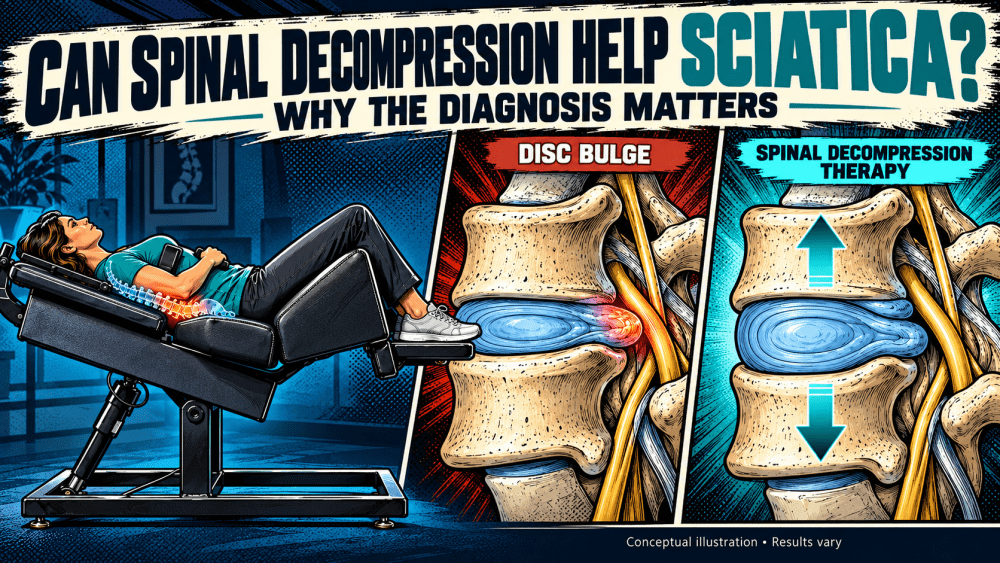
If spinal decompression is being considered, we discuss whether a monitored trial fits your condition. Evidence for traction-based decompression is limited, and it should not be promised to repair a disc or prevent surgery.
We also look at the activities you need to return to, whether that means lifting your children, working a full shift, or getting back to the gym.
When needed, I coordinate care with physical therapy, your primary care provider, pain management, or a spine specialist. Many disc problems improve without surgery, but worsening weakness or persistent disabling symptoms may require a surgical opinion.
If our office cannot provide the help you need, we will help you get to the right doctor.
How to Return to Work and Exercise
As symptoms settle, rebuild activity in steps. A better morning is a good opportunity for manageable movement, but it may be too soon to resume your heaviest workout.
Start with activities you tolerate, then increase their duration or difficulty gradually. Walking, controlled strengthening, and practicing everyday lifting can all be part of that progression. Exercise selection should reflect your examination and symptom response.
For a desk worker, that may mean more frequent position changes. For someone who lifts at work, it may mean temporarily lighter duties. Your plan should prepare you for the demands of your own life.
When to Seek Urgent Care
Seek emergency care for new trouble emptying your bladder, loss of bladder or bowel control, numbness around the groin, or rapidly worsening leg weakness. New foot weakness, foot dragging, or increasing numbness needs same-day evaluation. Severe back pain after a major accident, or back pain with fever or a cancer history, also needs urgent medical assessment.
Help for Recurring Low Back Flare-Ups in Charleston
If your back keeps flaring or leg symptoms are limiting your day, an evaluation can help clarify what is driving the problem and what to do next.
At Elite Family Chiropractic in West Ashley, we provide individualized back pain care in Charleston, with referrals and coordinated care when needed. Our goal is to help you move comfortably and return to the activities that matter to you.
Clinical references
[1] American Academy of Orthopaedic Surgeons. Herniated Disk in the Lower Back. Disc anatomy, nerve irritation, and recovery course.
[2] NHS. Slipped disc. Emergency symptoms and medication precautions.
[3] American Association of Neurological Surgeons. Herniated Disc. Evaluation, activity, imaging, and referral considerations.
[4] Albert HB, Hauge E, Manniche C. Centralization in patients with sciatica. European Spine Journal. 2012;21:630–636. Symptom response and prognosis.
[5] NICE. Low back pain and sciatica in over 16s. Imaging, exercise, manual therapy, and the recommendation against routine traction.
[6] NHS. Back pain. Heat, cold, activity, and symptom precautions.
Author
 Brad Gorski DC, FSBT
At Elite Family Chiropractic in Charleston, South Carolina, Dr. Brad Gorski is a top-ranked chiropractor offering effective treatment options for back pain, knee pain, neck and shoulder pain, sciatica, migraines, pinched nerves, herniated discs, and more. Dr. Gorski received his Doctor of Chiropractic degree from Palmer College of Chiropractic in Davenport, Iowa in 2008. He has completed extensive post-graduate training, becoming qualified in Hospital Based Spine Care, MRI Interpretation Review, and Trauma while also completing a Fellowship in Spinal Biomechanics and Trauma. He provides chiropractic care and helps his patients achieve their goal of optimum health and wellness.