Why Sciatica Hurts When Sitting
Learn why sitting can aggravate sciatica, how discs and buttock tissues may contribute, and how Elite Family Chiropractic in Charleston evaluates the cause.
By Dr. Brad Gorski, DC, FSBT | Elite Family Chiropractic
That ache deep in your buttock starts traveling down your leg. Sitting in the car makes it worse, and stretching only seems to help for a few minutes. Is the problem coming from your back, or is something in your hip irritating the nerve?
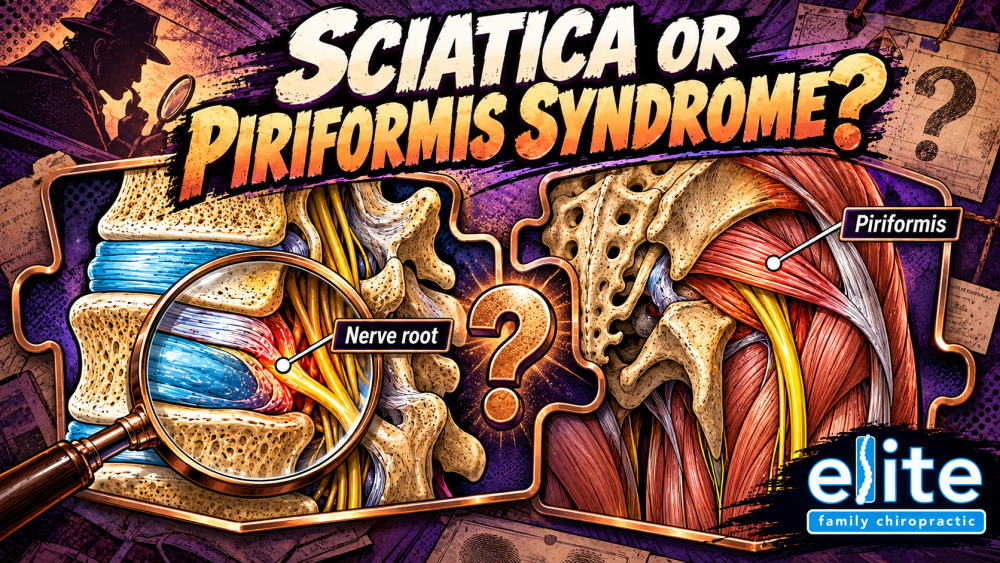
That is the question behind “sciatica or piriformis syndrome.” There is an important distinction: sciatica describes a pattern of nerve pain, while piriformis syndrome is one possible cause. The clinical question is whether the irritation begins at a nerve root in the lower spine or along the sciatic nerve deep in the buttock. [1, 2]
At Elite Family Chiropractic, I start by looking for the source of the symptoms. Where you feel the pain matters, but it does not always tell us where the problem begins.
The sciatic nerve forms from nerve roots that leave the lower spine. It travels through the pelvis, deep into the buttock, and down the back of the thigh before dividing into branches that continue into the lower leg and foot.
A herniated disc, narrowing around a nerve root, or inflammation near that root can produce pain farther down this pathway. You may feel burning, tingling, numbness, or an electric pain in the leg even though the source is near your spine. [1]
Farther along the pathway, the sciatic nerve usually passes underneath the piriformis, a small muscle deep in the buttock that helps rotate the hip. Irritation or compression associated with this muscle is called piriformis syndrome. Other muscles, tendons, and connective tissues in the same region can also affect the nerve. Clinicians use the broader term “deep gluteal syndrome” for nerve entrapment in this area. [2]
A sore piriformis muscle alone does not establish that the nerve is trapped. Buttock pain can also come from the lumbar spine, hip joint, sacroiliac joint, or hamstring attachment.
When the irritation begins in the lower spine, symptoms may change with bending, lifting, or particular back positions. Coughing or sneezing can sometimes reproduce the leg pain. Sitting may aggravate a disc-related problem, while some people with spinal narrowing feel worse with standing or walking.
One possible source is foraminal stenosis, which means narrowing of the opening where a nerve root exits the spine. A disc problem, bone spurs, or other changes can crowd that opening and sometimes irritate the nerve. However, seeing narrowing on an MRI does not automatically mean it explains your leg pain. The side, spinal level, and examination findings need to fit your symptoms.
The pain may travel into the calf or foot. An examination may identify changes in strength, sensation, or reflexes that fit a particular nerve root. These findings help us localize the problem, but their absence does not rule out nerve root irritation. [1, 3]
You can also have a lumbar source with little or no back pain. Feeling most of the pain in your buttock does not automatically make it a piriformis problem.
Piriformis-related symptoms often include a deep buttock ache or tenderness, sometimes with pain or tingling down the leg. Prolonged sitting, direct pressure on the buttock, or specific hip movements may reproduce the familiar symptoms. Some people notice them during running, climbing stairs, or repeatedly rotating the hip. [2]
These are clues, not a home diagnostic test. Sitting can aggravate either source, and pressing on a tender muscle does not prove it is responsible for all of the leg symptoms. Neurologic changes can also occur with sciatic nerve entrapment outside the spine.
The pattern across the history and examination matters more than any one symptom.
I want to know how the symptoms began, how far they travel, and what makes them better or worse. Did they start after lifting, a car wreck, a change in training, or a long period of sitting? Is there numbness, weakness, or a change in the way you walk?
The examination considers the lower back and hip together. It can include strength, reflex, and sensation testing; lumbar and hip movement; nerve tension testing; and assessment of tenderness and walking mechanics. Hip tests that activate or stretch the piriformis can help, but no single finding reliably settles every case. [3, 4]
A person may have more than one contributor. A lumbar problem can coexist with local buttock pain or muscle guarding. That does not mean every tender area needs the same treatment.
Not everyone with sciatica needs an MRI at the first visit. Imaging is most useful when it can answer a specific question and change the treatment plan. Progressive weakness, concerning examination findings, trauma, or persistent symptoms despite appropriate care may justify further investigation. [3, 5]
If there is little meaningful improvement over roughly four to six weeks, I reassess the working diagnosis and whether imaging or referral would help. That is a reassessment point, not a reason to wait when neurologic symptoms are worsening.
A lumbar MRI helps evaluate discs, nerve roots, and the spaces around them. If the suspected problem is outside the spine, a different evaluation may be needed. In selected cases, a specialist may recommend nerve testing or an image-guided injection to help clarify the source. A normal lumbar MRI does not, by itself, confirm piriformis syndrome. [2, 3]
A common response to buttock pain is to stretch the piriformis, pull harder on the hamstrings, or press a massage ball into the sore spot. That may feel helpful for some people, but an irritated nerve may react poorly to tension or direct pressure.
This applies whether the irritation is near the spine or in the buttock. A stretch that produces shooting pain, increasing tingling, or symptoms traveling farther down the leg should be stopped and reviewed with your clinician.
Temporary relief from stretching does not confirm the diagnosis, either. The goal is to choose movements that improve your function without repeatedly aggravating the nerve.
For more on why sitting can trigger symptoms from either region, read Why Sciatica Hurts When Sitting.
For a lumbar source, care may include individualized exercise, activity modification, and selected chiropractic or other manual treatment when appropriate. Manual care works within a broader plan that includes movement and rehabilitation. The plan should account for your neurologic findings and how you respond. [5]
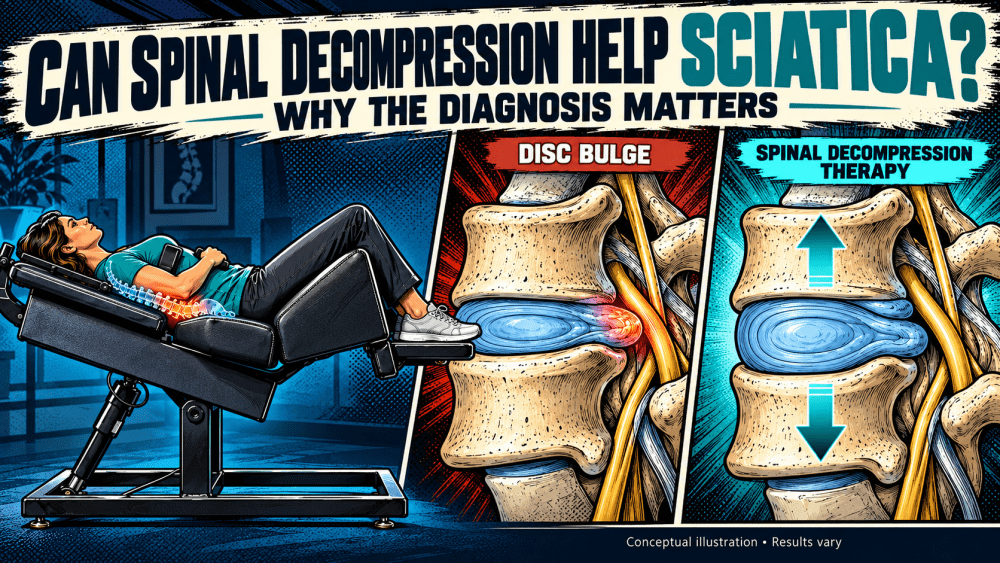
When the examination points toward a disc-related lumbar nerve-root problem, we may consider spinal decompression therapy as part of the plan. This nonsurgical treatment uses controlled traction on the lower spine and may help reduce leg pain in some patients. Research on traction is mixed, so a trial should have clear goals and regular reassessment. It is not appropriate for every patient and does not remove bone spurs or permanently reverse foraminal stenosis. [7]
When the findings point toward the piriformis region, care may focus more directly on the painful muscle and surrounding connective tissues. Shockwave therapy may be an option alongside hip strengthening, appropriate mobility work, and changes to activities that repeatedly aggravate the area. Small randomized studies have reported improvements in pain and function in patients treated for piriformis syndrome, although the best protocols and longer-term benefits need more study. [8]
That is a practical reason the diagnosis matters. A patient whose main problem is local piriformis irritation may need a different treatment emphasis from someone whose leg pain begins at a lumbar nerve root. When both regions contribute, the plan may address both.
Treatment response gives us another piece of information to interpret alongside the examination. For example, repeated improvement in leg pain and function with lumbar-directed care may support a lumbar contribution. Improvement in familiar buttock pain and hip function after local treatment may support a contribution from the piriformis region.
These are clinical clues rather than definitive diagnostic tests. Relief after decompression does not prove a disc is the source, and relief after shockwave does not confirm piriformis syndrome. Treatment can also ease muscle guarding or a coexisting problem. Likewise, failure to improve with one approach does not establish the other diagnosis.
We track progress in practical terms: less leg pain, better sitting and walking tolerance, improved sleep, and stable or improving strength. If progress stalls, we revisit the diagnosis and plan. Depending on the findings, that may involve working with physical therapy, primary care, pain management, orthopedics, or neurosurgery.
If buttock pain or radiating leg symptoms keep returning, a careful evaluation can help determine whether the lower spine, deep hip region, or another condition needs attention.
At Elite Family Chiropractic in West Ashley, my fellowship training in spinal biomechanics and trauma informs how I evaluate the spine, movement, and injury history. We build the care plan around the findings and coordinate with other providers when needed.
We are committed to helping determine what you need. If your symptoms are interfering with sleep, work, or daily activity, contact Elite Family Chiropractic to schedule an evaluation.
1. American Academy of Orthopaedic Surgeons. Herniated Disk in the Lower Back.
3. American Association of Neurological Surgeons. Herniated Disc.
5. National Institute for Health and Care Excellence. Low back pain and sciatica in over 16s. NG59.
6. National Health Service. Sciatica.