

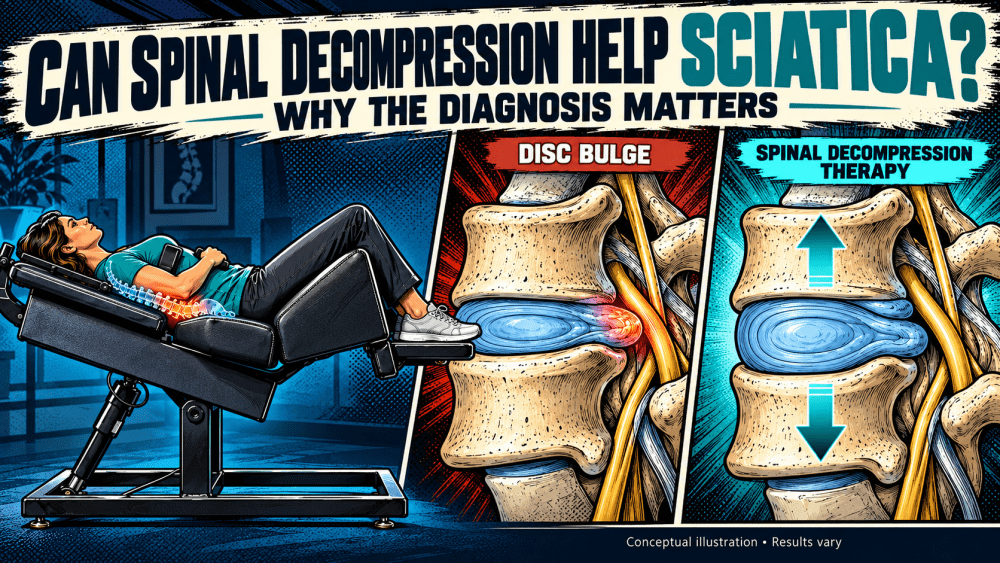
Can Spinal Decompression Help Sciatica? Why the Diagnosis Matters
Can spinal decompression help sciatica? Learn why identifying the cause of leg pain matters and how decompression may fit into a personalized, nonsurgical care plan.

By Brad Gorski, DC, FSBT | Elite Family Chiropractic | Charleston, SC
Have you ever experienced pain at the top of your shoulder, right where your neck and shoulder meet? Maybe it feels like a tight knot in your upper trapezius muscle. Or perhaps the discomfort travels toward the top of your shoulder blade.
Most people naturally assume they have a shoulder problem or a tight muscle.
But that's not always the case.
Sometimes pain felt at the top of your shoulder is actually coming from your neck. Other times, the shoulder itself is responsible. And in some patients, both areas contribute to the problem.
One of the first things I try to determine when evaluating someone with this type of pain is whether the primary source is the cervical spine (neck), the shoulder, or a combination of the two.
That distinction matters because the location of your pain doesn't always tell us where the problem begins.
Your neck, upper back, and shoulders work together through a complex system of joints, muscles, connective tissues, and nerves.
The cervical spine contains seven vertebrae. Between these bones are intervertebral discs, and along the back of the spine are small joints called facet joints.
These joints help guide movement as you turn your head, look upward, or bend your neck from side to side.
Each facet joint is also surrounded by a capsule containing ligamentous connective tissue that helps support and control spinal motion.
What many people don't realize is that these joints can produce pain in areas away from the neck itself.
This is called referred pain.
Referred pain occurs when discomfort originating from one structure is experienced in another location.
For example, an irritated cervical facet joint may produce discomfort across the upper trapezius, near the top of the shoulder, or around the shoulder blade.
The shoulder may hurt even though the primary problem is located in the neck.
Research has documented recognizable patterns of pain referral from cervical facet joints.
In a 1996 study, Fukui and colleagues investigated pain referral from cervical facet joints and related nerves. Their findings demonstrated that different cervical levels could produce pain extending into areas around the neck, upper shoulder, and shoulder blade.
A later study by Cooper, Bailey, and Bogduk in 2007 examined patients with cervical facet joint pain assessed through diagnostic blocks and developed maps illustrating these referral patterns.
These studies help explain why someone can experience discomfort around the shoulder blade even when the painful structure is located in the cervical spine.
However, the patterns overlap.
We cannot diagnose a particular facet joint simply because someone points to a specific location on their shoulder.
That's where a proper examination becomes important.
For a deeper discussion, read our article on why neck pain keeps coming back: facet joint pain after whiplash.
This is one of the most important questions we try to answer during an examination.
When someone comes into my office complaining of pain across the top of their shoulder or near their shoulder blade, I don't automatically assume it's a shoulder injury.
Instead, I begin by evaluating how the neck and shoulder move and whether particular movements reproduce the patient's familiar symptoms.
One of the first things I evaluate is cervical range of motion.
I'll assess what happens when a patient turns their head, looks upward, bends forward, or tilts their neck from side to side.
If these movements reproduce the same pain the patient experiences across the top of their shoulder, that raises suspicion that the cervical spine may be contributing to their symptoms.
For example, someone might say:
"My shoulder hurts whenever I turn my head to the right."
That information is meaningful because the painful movement involves the neck rather than the shoulder joint itself.
It doesn't establish a diagnosis, but it helps us determine what structures need further evaluation.
Another part of my examination involves applying controlled pressure around specific cervical joints and surrounding tissues.
In some patients, pressure directed toward a particular area of the cervical spine reproduces their familiar discomfort near the shoulder blade.
They may say:
"That's exactly the pain I've been feeling in my shoulder."
This is an important clinical finding.
It suggests that structures within or around the neck may contribute to the pain experienced farther away.
However, reproducing pain with pressure does not, by itself, prove that a particular facet joint is responsible. Muscles, ligaments, and other cervical structures can produce overlapping symptoms.
We use these findings together with the patient's history, movement patterns, neurological examination, and other clinical information.
Next, we evaluate the shoulder itself.
I'll look at movements such as:
Raising the arm overhead.
Reaching behind the back.
Rotating the shoulder.
Performing resisted shoulder movements.
Applying pressure around the shoulder and acromioclavicular (AC) joint.
If shoulder-specific movements reproduce the patient's familiar pain while neck movements have little effect, that may point us toward a primary shoulder problem.
But sometimes both examinations reveal abnormalities.
A patient can have cervical facet joint irritation and a rotator cuff injury at the same time.
Our job is to recognize when one area is responsible, when both are involved, and which findings are most relevant to the patient's symptoms.
Several conditions can create similar symptoms, even though they involve different anatomical structures.
Facet joint neck pain can produce a deep, aching discomfort in the neck that refers into the upper trapezius or shoulder blade region.
Patients may notice that turning their head, looking upward, or holding certain positions makes their symptoms worse.
Following an injury, the facet joint and its surrounding ligamentous capsule may become irritated or damaged.
These structures play an important role in guiding and limiting spinal movement.
In selected patients, injury to supporting connective tissues may contribute to altered joint mechanics and persistent symptoms.
But not every patient with facet-related pain has ligament damage or spinal instability.
The examination, history, and additional testing when indicated help us understand what may be contributing.
Two muscles frequently associated with pain around the top of the shoulder are the upper trapezius and levator scapulae.
Both connect the neck and shoulder region and help control movement of the head and shoulder blade.
When irritated, they may become tender, tight, or painful during certain activities.
Muscle-related pain can be a primary problem.
However, there's another important possibility.
Sometimes the muscle is reacting to pain or irritation coming from a nearby cervical joint.
Muscles surrounding an irritated joint may increase their activity or become guarded in response to discomfort.
This is one reason a patient may experience temporary improvement after massage or stretching but continue to have recurring symptoms.
It's not necessarily that the treatment was ineffective. The treatment may have addressed a painful muscle without addressing every factor contributing to the symptoms.
Research by Castaldo and colleagues in 2014 identified more active myofascial trigger points in patients with whiplash-associated disorders than in a comparison group with mechanical neck pain.
These findings support the importance of evaluating muscular involvement, although muscle tenderness alone cannot tell us whether the original problem began in the muscle or another structure.
Not all pain near the top of the shoulder comes from the neck.
The shoulder contains several joints, muscles, tendons, and ligaments that can become irritated or injured.
The rotator cuff helps stabilize and move the shoulder. Injury or irritation may produce pain during overhead activities, reaching, lifting, or lying on the affected side.
The AC joint is located at the top of the shoulder, where the collarbone meets part of the shoulder blade.
AC joint problems may produce localized tenderness and discomfort when bringing the arm across the body.
These conditions can sometimes resemble referred pain from the cervical spine.
The difference becomes clearer when we compare shoulder-specific examination findings with cervical examination findings.
An irritated cervical nerve root can also cause pain around the shoulder blade.
Unlike typical facet joint referred pain, cervical radiculopathy may involve symptoms traveling into the arm or hand.
Patients may describe:
Burning, sharp, or electric pain.
Numbness or tingling.
Changes in sensation.
Weakness in the shoulder, arm, or hand.
However, not every patient with cervical nerve irritation experiences all these symptoms.
A 2025 research review by Carmichael and colleagues found that scapular pain is frequently described in patients with cervical radiculopathy and may sometimes appear before arm symptoms.
This reinforces why we cannot rely on the location of pain alone.
A neurological examination can help determine whether nerve involvement needs further evaluation.
Learn more about pinched nerve symptoms and treatment options.
Yes, and this is particularly important following a motor vehicle collision.
During a collision, the cervical spine may experience rapid changes in acceleration and direction.
These forces can load the cervical facet joints, their surrounding ligamentous capsules, muscles, and other supporting tissues.
In some cases, the result is neck pain that refers toward the top of the shoulder or shoulder blade.
In others, the patient may have an actual shoulder injury.
For example, bracing against the steering wheel, direct impact, or seatbelt loading can place forces on the shoulder.
The result may involve a rotator cuff injury, AC joint irritation, or another shoulder condition.
A 2008 study by Abbassian and Giddins highlighted the importance of identifying shoulder pathology, particularly subacromial impingement, in patients evaluated after whiplash injuries.
That's why I believe examining both regions is so important following trauma.
Someone may have a cervical injury contributing to referred shoulder pain while also having a separate shoulder injury from the same collision.
If we only examine one region, we risk overlooking the other.
For more information, see our articles on neck stiffness after a car accident and the role of ligament injury and commonly missed injuries after car accidents.
This is an important question, especially when someone has already tried massage, stretching, exercises, or other conservative treatments.
Sometimes patients experience temporary relief, but the discomfort returns when they resume normal activities.
There are several possible explanations.
The original diagnosis may have been incomplete. The muscles may have improved while an irritated cervical joint remains symptomatic. Or the patient may have several contributing problems that require different treatment approaches.
Other times, persistent pain may involve reduced strength, endurance, movement control, or continued exposure to activities that aggravate the region.
One principle that guides how I practice is that treatment should follow the diagnosis, not simply the location of the pain.
If someone has been receiving treatment directed toward the upper trapezius without lasting improvement, that doesn't automatically mean they have a facet joint injury.
But it does tell us that we may need to reassess the condition and look more closely at other possible sources of pain.
Repeatedly treating the same area without understanding why symptoms return may not provide the best long-term outcome.
Not necessarily.
Many patients can be evaluated initially through a detailed history and physical examination.
However, imaging may become appropriate depending on how symptoms began, the severity of the problem, neurological findings, and the patient's response to care.
For example:
X-rays may help evaluate bony alignment, degenerative changes, or certain traumatic injuries.
MRI may provide additional information about cervical discs, nerve roots, spinal cord structures, and some connective tissue injuries.
Shoulder imaging may be appropriate when examination findings suggest a significant shoulder injury.
A cervical MRI does not automatically identify whether a facet joint is causing pain, and not every connective tissue injury is visible on routine imaging.
In selected patients, additional diagnostic evaluation may be needed to better understand the source of their symptoms.
The objective is not to order every available test.
It's to determine which information will meaningfully influence the diagnosis and treatment plan.
The treatment depends on what we identify during the evaluation.
For some patients, the primary issue involves cervical joint irritation and restricted movement.
Others may have muscular dysfunction, nerve irritation, a shoulder injury, or a combination of findings.
Depending on the diagnosis, conservative management may include chiropractic adjustments or gentle mobilization, therapeutic exercises, activity modification, Class IV laser therapy, and other appropriate treatments.
When rehabilitation is needed, we may focus on improving cervical mobility, shoulder blade control, muscular strength, and the patient's ability to tolerate normal activities.
In more complex cases, particularly following trauma or when symptoms are not improving as expected, additional imaging or referral may be appropriate.
This is where collaborative spine care becomes important.
At Elite Family Chiropractic, I regularly coordinate with physical therapists, pain management physicians, orthopedic specialists, and other healthcare providers when their expertise can improve a patient's care.
The goal isn't to make every shoulder complaint fit a chiropractic diagnosis. It's to identify the problem and help the patient receive the right care.
If discomfort around the top of your shoulder persists, repeatedly returns, or interferes with sleep, work, or everyday activities, a clinical evaluation may help identify the source.
Evaluation is particularly important when symptoms begin after a car accident, fall, or other injury.
Numbness, tingling, significant loss of motion, or noticeable weakness also deserve attention.
Progressive arm weakness, new difficulty walking or maintaining balance, or changes in bowel or bladder control require urgent medical assessment. Severe symptoms following significant trauma should also be evaluated promptly.
The sooner we understand what structures may be involved, the sooner we can establish an appropriate management plan.
Turning your head moves the cervical spine and activates muscles connected to the shoulder blade. If those movements reproduce your familiar pain, the neck may be contributing. Cervical facet joints, muscles, discs, and nerve roots can all produce symptoms around the shoulder blade.
Yes. Cervical facet joints can refer pain into the upper shoulder and scapular region. Some patients notice the referred discomfort more than the neck pain itself. However, this pattern is not specific enough to diagnose facet joint pain without further evaluation.
Muscle tenderness, painful cervical movements, and reproduction of familiar symptoms during examination can provide useful clues. However, trapezius tenderness can occur independently or alongside cervical joint problems. A focused examination helps determine which structures may be contributing.
Yes. Cervical nerve root irritation can sometimes cause shoulder blade discomfort before more recognizable neurological symptoms develop. The absence of numbness or tingling does not completely rule out nerve involvement.
Yes. A motor vehicle collision can place forces on the cervical spine and shoulder at the same time. Some patients experience referred pain from the neck, while others develop a separate shoulder injury. Both problems may occur together.
Recurring symptoms can have several explanations, including persistent joint irritation, muscular dysfunction, incomplete rehabilitation, or more than one source of pain. When symptoms repeatedly return, reassessing the diagnosis and treatment plan may be more helpful than simply repeating the same treatment.
Pain across the top of your shoulder or around your shoulder blade can be frustrating, especially when you aren't sure where it's coming from.
Sometimes the answer is relatively straightforward: a muscular problem or local shoulder injury.
Other times, the pain may originate from the cervical spine, including the facet joints, discs, or nerve roots.
And sometimes more than one structure is involved.
In my practice, the first priority is understanding where the problem is coming from. That means evaluating movement, reproducing familiar symptoms when appropriate, assessing neurological function, and considering the patient's history.
Only then can we make informed decisions about treatment.
At Elite Family Chiropractic in Charleston, SC, our approach focuses on individualized nonsurgical spine management, appropriate diagnosis, and collaboration with other healthcare professionals when needed.
If you're experiencing persistent pain at the top of your shoulder or around your shoulder blade, learn more about our neck pain treatment, shoulder pain care, and car accident chiropractic evaluations.
Our goal is to help you understand the cause of your symptoms, develop the right management plan, and return to the activities that matter most.
Fukui S, et al. Referred pain distribution of the cervical zygapophyseal joints and cervical dorsal rami. Pain. 1996;68(1):79–83. PubMed
Cooper G, Bailey B, Bogduk N. Cervical zygapophysial joint pain maps. Pain Medicine. 2007;8(4):344–353. PubMed
Castaldo M, et al. Myofascial trigger points in patients with whiplash-associated disorders and mechanical neck pain. Pain Medicine. 2014;15(5):842–849. PubMed
Abbassian A, Giddins GE. Subacromial impingement in patients with whiplash injury to the cervical spine. Journal of Orthopaedic Surgery and Research. 2008;3:25. PubMed
Carmichael J, et al. Scapular pain in cervical radiculopathy: A scoping review. North American Spine Society Journal. 2025;23:100619. PubMed
Hurley RW, et al. Consensus practice guidelines on interventions for cervical spine (facet) joint pain from a multispecialty international working group. Pain Medicine. 2021;22(11):2443–2524. PubMed


