


When Does Back Pain Need Imaging? X-rays, MRI, and What They Tell Us
Do you need an X-ray or MRI for back pain? Dr. Gorski explains when imaging helps, warning signs, and what to expect from an evaluation in Charleston.
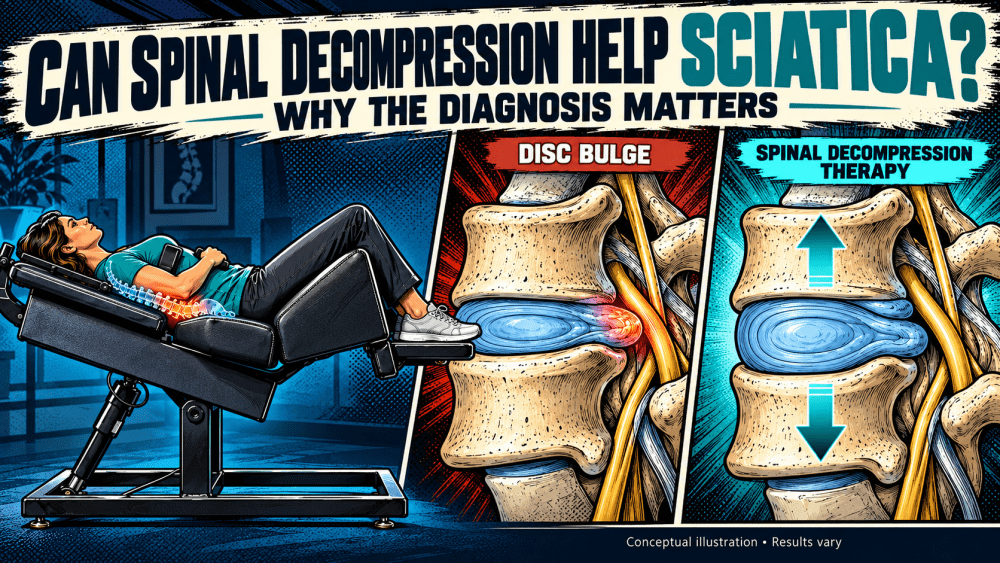
When pain shoots from your lower back into your leg, even simple things can become difficult. Sitting through dinner, driving to work, or getting a good night’s sleep may feel like a challenge.
Many patients ask the same question: “Can I get better without surgery?”
For some patients, spinal decompression may be one option within a conservative treatment plan. The first step is figuring out why the pain is traveling down your leg. Once we understand the cause, we can better decide which treatments make sense.
Think of sciatica like a warning light on your dashboard. The light tells you something needs attention, but it does not tell you which part needs help.
Sciatica commonly describes pain traveling from the lower back or buttock into the leg. It may feel sharp, burning, or electric. Some people also experience numbness or tingling.
A disc herniation, narrowing around a spinal nerve, or other changes in the lower back may cause these symptoms. However, pain from nearby joints and muscles can sometimes feel similar.
That is why treating every case of leg pain the same way can miss the problem. The diagnosis should guide the treatment.
Yes—where your symptoms travel gives us useful clues.
Think of your nerves as roads carrying messages between your spine and the rest of your body. The path your symptoms follow can help a doctor figure out where those messages may be getting interrupted.
Pain that stays in the buttock or thigh may have a different source than pain with tingling into the foot. But there is no firm dividing line at the knee. Sciatica can travel into the foot, and nerve problems do not always follow a perfect pattern.
You may also hear the term radiculopathy. This means a nerve root near the spine is not working normally. Along with pain, a person may have reduced feeling, muscle weakness, or changes in reflexes.
Put simply, pain can tell us a nerve is irritated. Changes in strength or feeling can tell us more about how that nerve is functioning.
A doctor’s examination helps sort out these differences. Where the pain stops is only one piece of the picture.
The discs between your spinal bones act somewhat like cushions. Nearby nerves need enough room to travel out of the spine.
When a disc herniates or that space becomes narrow, a nerve may become irritated. Inflammation can also contribute to the pain.
Spinal decompression therapy uses a treatment table to apply a gentle, controlled pulling force to the spine. This is called traction.
Think of it as gently unloading an area that has been under stress. The goal is to change the forces around the spinal discs and joints, which may help ease symptoms for some patients.
It does not remove a herniated disc or guarantee that disc material moves away from a nerve. Research on its benefits is mixed, and results vary. That is why treatment should have a clear purpose and regular checks to see whether it is helping.
Surgical and nonsurgical decompression take different approaches.
During surgery, a surgeon may remove a piece of herniated disc or other tissue that is pressing on a nerve. Table-based decompression uses controlled pulling forces without an incision or removal of tissue.
For patients hoping to avoid back surgery, it may be reasonable to discuss whether decompression belongs in their conservative care plan.
The key is knowing when a trial of conservative care is appropriate and when a surgical opinion is needed. Seeing a surgeon does not automatically mean having surgery. Sometimes it helps clarify the options.
An irritated back often needs more than one type of support.
Think about a sore ankle. Giving it some relief may help, but returning to activity also takes movement, strength, and changes to whatever keeps aggravating it.
The same idea applies to spine care. Depending on your condition, decompression may be combined with:
Chiropractic care: Address restricted joint movement when appropriate.
Class IV laser therapy: Help manage pain and support tissue recovery.
Shockwave therapy: Address certain muscle and tendon problems that may contribute to your discomfort.
Heat therapy: Ease muscle tension and stiffness.
Interferential electrical stimulation: Help reduce pain with gentle electrical currents.
Trigger point therapy: Address sensitive, tight areas in muscles that may contribute to local or referred pain.
Activity guidance: Adjust lifting techniques, sitting positions, work tasks, and exercise to reduce repeated irritation while staying active.
At Elite Family Chiropractic, we build the plan around the person. Your symptoms, examination, daily demands, and response to care help guide what comes next.
Progress should show up in everyday life.
Can you sit through a meal more comfortably? Walk farther? Sleep with fewer interruptions? Is the leg pain happening less often?
We also pay attention to numbness and weakness. Less pain is encouraging, but how the nerve is functioning matters, too.
If care is not helping, the next step is to reassess. That may mean changing treatment, considering imaging, or working with physical therapy, pain management, or a spine surgeon.
New or worsening leg weakness, a foot that begins dragging, or increasing difficulty walking needs prompt medical evaluation.
New trouble controlling your bladder or bowels, difficulty passing urine, or numbness around the groin requires emergency evaluation.
These symptoms should not wait through a course of decompression treatment.
Spinal decompression may have a role in helping selected patients manage sciatic symptoms alongside other conservative measures.
The starting point is understanding what is causing your pain and whether this treatment fits your condition.
At Elite Family Chiropractic, our goal is to help you move better, return to daily life, and understand your options. If you need another provider’s expertise, we will help coordinate that care.
You deserve a clear explanation, a plan built around your needs, and follow-up that shows whether you are making progress.


