

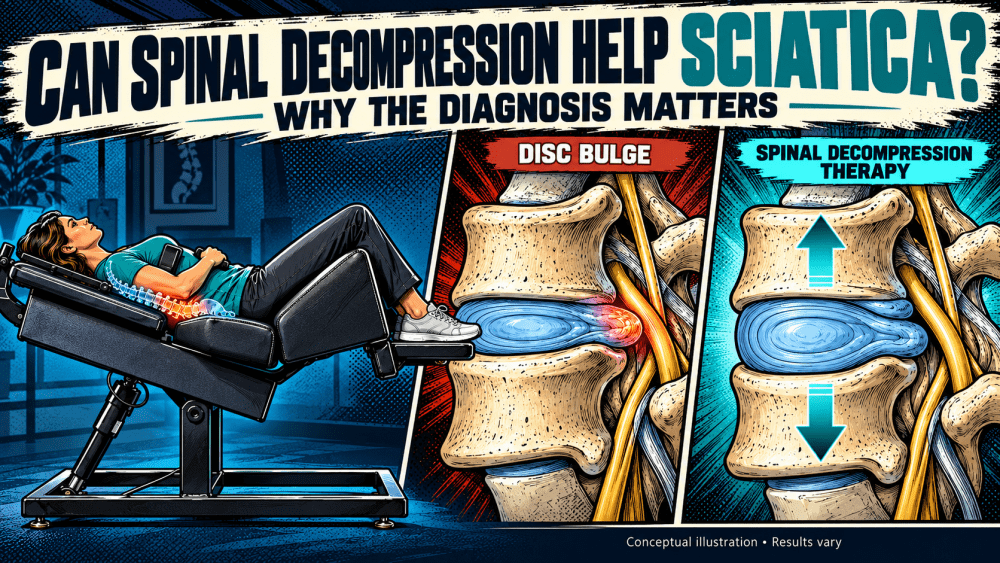
Can Spinal Decompression Help Sciatica? Why the Diagnosis Matters
Can spinal decompression help sciatica? Learn why identifying the cause of leg pain matters and how decompression may fit into a personalized, nonsurgical care plan.

That sharp pain down the leg when you stand up, the numbness in your foot during a drive, the ache that gets worse after sitting too long - those are the moments when a disc bulge stops feeling like a vague diagnosis and starts disrupting daily life. Chiropractic care for disc bulge is often sought by people who want a non-surgical option, but the right approach depends on more than the MRI report. It depends on the type of bulge, the nerves involved, your symptoms, and whether the spine is stable enough to respond well to conservative care.
A disc bulge happens when the outer fibers of a spinal disc weaken and the disc extends beyond its usual boundary. That does not always mean severe pain. Some bulges are incidental findings, while others irritate nearby nerves and create low back pain, sciatica, neck pain, tingling, or weakness into the arm or leg. The real clinical question is not simply whether a bulge exists. It is whether that bulge matches the symptoms and whether the mechanics of the spine are making the problem worse.
Many disc bulges respond well to conservative treatment, especially when care is designed around the patient rather than applied as a standard routine. In the right case, chiropractic treatment may help reduce joint restriction, improve spinal movement, decrease muscle guarding, and lower mechanical stress on irritated tissues. That can create the conditions for pain to calm down and function to improve.
This is especially true when the pain is driven by a combination of disc irritation, inflammation, and poor movement patterns. A person may not need surgery, but they do need a clear diagnosis and a treatment plan that respects the disc injury. That is where precision matters. Gentle, targeted treatment can be appropriate. Aggressive treatment in the wrong patient is not.
Patients with a disc bulge often ask whether chiropractic adjustments can push the disc back into place. That is not a realistic way to think about it. A bulging disc is not like a button that gets popped back in. The goal is to improve biomechanics, reduce abnormal loading, ease nerve irritation, and help the spine function better while the body heals. For many people, that leads to less pain and better mobility even if the MRI wording does not dramatically change.
Before treatment begins, the most important step is determining whether chiropractic care is appropriate at all. Not every disc bulge should be adjusted, and not every patient with radiating pain has a simple disc issue.
A proper evaluation should include a detailed history, orthopedic and neurological testing, and a review of symptom patterns such as numbness, weakness, reflex changes, pain distribution, and positions that worsen or relieve symptoms. Imaging may or may not be necessary at the first visit, but when an MRI already exists, it should be interpreted in the context of the exam rather than treated as the whole story.
That distinction matters. A patient can have a moderate disc bulge on imaging and little to no symptoms. Another can have a smaller bulge in a more sensitive location and significant nerve pain. The exam helps connect the anatomy to the actual problem.
For patients with trauma history, persistent sciatica, worsening weakness, or failed prior treatment, the evaluation needs to be even more thorough. In these cases, advanced understanding of spinal biomechanics, trauma patterns, and MRI findings can shape safer and more effective decisions.
Chiropractic care for a disc bulge is rarely just one thing. It is often a combination of strategies chosen to match the stage and severity of the condition.
If the disc is highly inflamed and nerve symptoms are active, the early phase of treatment may focus on reducing irritation rather than forcing movement. That can include gentle positioning, flexion-distraction or spinal decompression-based approaches when appropriate, soft tissue work, activity modification, and specific home recommendations. If the spine has areas of restricted motion above or below the injured segment, carefully selected adjustments may help reduce compensatory stress.
As pain settles, treatment may shift toward restoring better movement and stability. That often includes exercises to improve core control, hip mobility, posture, and tolerance for sitting, bending, lifting, or athletics. Without that progression, many people feel better temporarily but flare up when they return to work, the gym, or travel.
The phrase it depends is not a dodge here. It is honest medicine. Someone with a disc bulge and mild intermittent leg pain may respond quickly. Someone with severe nerve compression, muscle weakness, and months of compensation may improve more slowly and may need co-management or referral.
This is a fair question, and patients should ask it. The answer is that any treatment must fit the condition. In the wrong case, forceful manipulation can aggravate symptoms. In the right case, with the right technique and screening, chiropractic care can be both safe and helpful.
That is why technique selection matters. A clinician should consider the location of the bulge, the degree of nerve involvement, the irritability of symptoms, the patient’s age, trauma history, and how the person responds during the exam. Some patients do better with low-force methods. Others tolerate more traditional manual treatment well. Some need treatment away from the most inflamed segment first.
Red flags also matter. Progressive weakness, loss of bowel or bladder control, saddle numbness, severe unrelenting pain, fever, unexplained weight loss, fracture suspicion, or signs of significant spinal instability require immediate medical evaluation. Conservative care has value, but it should never replace good clinical judgment.
The best outcomes usually come when expectations are realistic. Chiropractic care may help reduce pain, improve movement, and decrease nerve irritation, but healing time varies. Discs heal slowly because they have limited blood supply. Even when symptoms begin improving in a few visits, the tissue itself may need much longer to settle.
Patients often notice changes in stages. First, sharp pain may become less constant. Then mobility improves. Then daily activities become easier. Numbness and tingling can take longer than pain to resolve, and strength deficits deserve close monitoring. Recovery is not always linear. A long car ride, poor sleep, yard work, or an early return to heavy lifting can trigger setbacks.
That does not mean treatment failed. It means the spine is still recovering and the plan may need to be adjusted. A thoughtful provider explains that process clearly so patients understand what progress should look like and when additional imaging or referral is warranted.
In general, good candidates are people with mechanical neck or back pain, sciatica or arm pain linked to disc irritation, and no signs that surgery or emergency care is immediately needed. They want an approach that is conservative but not casual - one built on diagnosis, symptom monitoring, and function.
This often includes working adults who sit for long hours, active people who lifted awkwardly or trained through warning signs, and patients recovering from auto accidents where disc injury may be part of the problem. It can also include those who have tried medication and rest but still feel limited.
Less ideal candidates are those who want a one-visit fix, ignore activity restrictions, or have neurological decline that needs more urgent intervention. The goal is not to fit everyone into chiropractic care. The goal is to identify who can benefit, who needs modified treatment, and who should be referred.
At a clinic like Elite Family Chiropractic, that level of decision-making matters because patients are not all walking in with simple stiffness. Some are dealing with sports injuries, post-traumatic spine problems, persistent sciatica, or disc findings that require more than a generic treatment plan.
Disc bulges can look straightforward on paper and be complex in real life. The symptoms may reflect the disc itself, the facet joints, inflamed nerve roots, muscular guarding, altered gait, or a combination of all of them. That is why experience in trauma, spinal biomechanics, neurological findings, and imaging interpretation can change the quality of care.
The difference is not just academic. It affects what gets treated, what gets avoided, and when the plan changes. A patient with calf weakness and reduced reflexes is not managed the same way as a patient with local low back pain only. A patient whose pain centralizes with extension is different from one whose symptoms worsen every time they bend backward. Those details shape treatment.
For patients, the practical takeaway is simple. If you are considering chiropractic care for a disc bulge, look for a provider who takes the diagnosis seriously, performs a real exam, explains the reasoning behind treatment, and knows when conservative care is appropriate and when it is not.
Pain from a disc bulge can make everyday life feel smaller than it should. The right care should do more than chase symptoms for a few days - it should help you move with more confidence, protect the injured area, and give you a clearer path back to normal life.


